

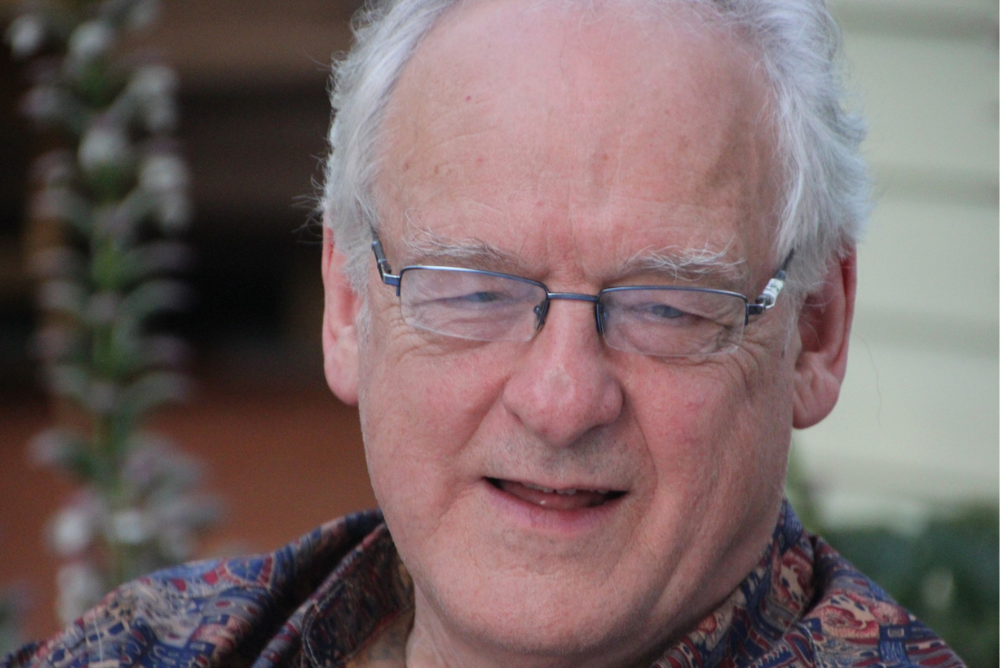
Dear comrades, it is with great sadness that we announce the passing, on Monday, February 2, 2026, of our beloved David Legge, health activist, co-founder of the PHM, but above all a beloved man, friend, leader, and role model for activists around the world.
We honor David's life, his struggle for health for all, and his commitment to the People's Health Movement (PHM), the movement to which he devoted his efforts and love.
We extend our condolences and solidarity to David's family and loved ones.
David: We will always remember you as one of our heroes in the struggle for health.
We are sharing the link created by his family to send messages of solidarity and tribute to David. Please send your messages and tributes to David Legge by following the link below.
Send your messages and triubutes to David Legge: https://www.facebook.com/share/p/188diEXVNA/
.png)
.png)
David Legge's reflections at the PHM 25th anniversary commemoration
Here is a picture of what we've done for the last 25 years. Over here we've got the charter, the Quaker declaration from 2005. The down here is Cape Town in 2012. Again back to Savar in 2018 and then last year in Mar del Plata. And then all the activities that have been going on.
There is something wonderful here to be celebrated I think. I'm looking at um Global Health Watch 7 over here. 110 issues of people's health dispatch. Um the long work of PHM exchange, the IPHU's and the WHO watch team. And these are just the global programs.
It doesn't speak about the amazing work which has been undertaken at the uh country level. So, what I'd like to do is to talk about changing context in terms of five broad areas. In some respects, the context hasn't changed all that much, but in other respects, it's quite important to identify some differences.
So, under the heading of social determination of people's health, the challenges of poverty, precarious employment, inequality, and alienation of people from each other, from the Earth, from their own agency and from their own creativity. These are problems which remain and the lack of government expenditure on social infrastructure.
Then in terms of health prospects, the lack of public health funding, the continued pressure for privatization and marketization, they are standard, but this whole process of financialization And the globalization of private healthcare providers is relatively new and we need to think about how we're responding to that.
And then of course the continuing flow of new treatments and new diagnostics and new inequities in access. New technologies are also threatening to change things and we need to work out why and how. One of them is cross-border healthcare which needs to be thought through.
I'm not going to do so today but it's going to be a key issue as well as new forms of stratified access or denial of access. But I'd also like to highlight the role of taylorism in healthcare management which is going to be intensified by the new technologies which again is going to change the fields in which we work.
Under the heading of cultural and environmental trends, clearly global heating is a dominating issue with the disasters, the migration, the conflict which is going to flow from that.
And with those come other more familiar issues, the escalating extractivism, but the impact of new technologies, including Which are going to change the world in which we are working.
I want to highlight the divide and conquer dynamic on this slide including the rise of fascism and the fascism which rises from alienation and grievance but also the role of various oppressions across gender across race and religion and the ways in which they divide people and present and weaken our resistance to imperialism.
Under the heading of geopolitics, um we've moved from European colonialism of theft and slavery to US neo-colonialism, which was all about unequal exchange imposed by imperial force 3000 of the so-called rules based order which was neoliberal multilateral and how we are moving to to the bilateral bullying and of Trump.
But what's different now is the rising of multi-polar resistance. And just what by way of illustrating that I mention the rejuvenation of the G77, the non-aligned movement, the BRICS plus.
And the recent G19 statement where 19 members of the G20 said that it didn't matter if the Americans didn't come to the G20, they produced their statement anyway. So there is a multi pillar movement happening which we need to work with. Imperialism is not going to accept that without a struggle.
And as Pope Francis said some years ago, World War III is being waged peace by peace.
Palestine, Venezuela, Ukraine So finally I want to focus on the changing dynamics of transnational capitalism which has moved from the naked looting of colonialism to the long boom after the second world war to the 1980s debt crisis.
Through to a new period of financialization Where the financial system dominates the way capitalism works and we have a new and deepening debt crisis as a consequence of the increasing greed of the financial system.
PHM needs to be confronting the dynamics which underpin the inequality and the imperialism we've talked about. And I want to highlight underconsumptionism.
The fact that capitalism is generating more capital than it can invest and that capital is flowing into the financial system which is flowing into debt which is flowing into new forms of expropriation. We need to understand the deepening of unequal exchange under the liberalization of trade and finance.
But there is also resistance and we need to continue to work out what a new international economic order would mean and I would be returning to some of Amin's concept of delinking which is about weakening the bonds of imperialism. And that's happening.
The Belton Road initiative, the Asian infrastructure in bank investment banks and the decline of dollar denomination with Central Bank currencies are all small signs of a resistance to US dominated capitalism. As well as the resistance to extractivism.
So, what do I get from reflecting through this history of what we've been doing? I want to highlight some of the strategic principles which came out of Mar del Plata. Popular mobilization, reaching across marginalized constituencies, reaching across differences, building solidarity and liberation.
convergence of new and deeper alliances with other social movements including labour unions and left political parties including the Nyéléni process that we've been part of working with progressive governments to resist imperialism working at the national level to resist domestic capital and the domestic incursions of transnational capitalism.
And the capacity building that is needed to make those things happen. So, I then go back to our core documents. And to be honest, our analysis has not changed all that much. Capitalism is destroying civilization and degrading nature. Imperialism can be overcome.
Ecosocialism is possible and it would bring decent jobs, fair societies, free time, eco harmony and living well but what has changed since December 2000 is that PHM has been much more explicit in this narrative about capitalism, about imperialism and about an eco-socialist alternative.
Because if we are going to build a process of mobilization, we need to be clearer about our critique, the critique of capitalism. We need to be clear about what kind of world we're talking about building.
If we're going to build a convergence with other social movements, we need to explain more clearly why we see capitalism as such a critical structure to be confronted and why an eco-socialist world is both possible and necessary.
Likewise, if we're working with So I guess I guess what I'd like to leave for the panel to consider is that our analysis and our broad strategy remain pretty strong from 2000 onwards and have been reinforced repeatedly.
But maybe we need to be explicit in offering an alternative: a stronger clearer critique of what we're confronting and a more exciting vision, a more explicit clearer vision of what we are working towards. I think I might leave it there.