
The PHM stands in solidarity with the Colombian people following the August 10 earthquake
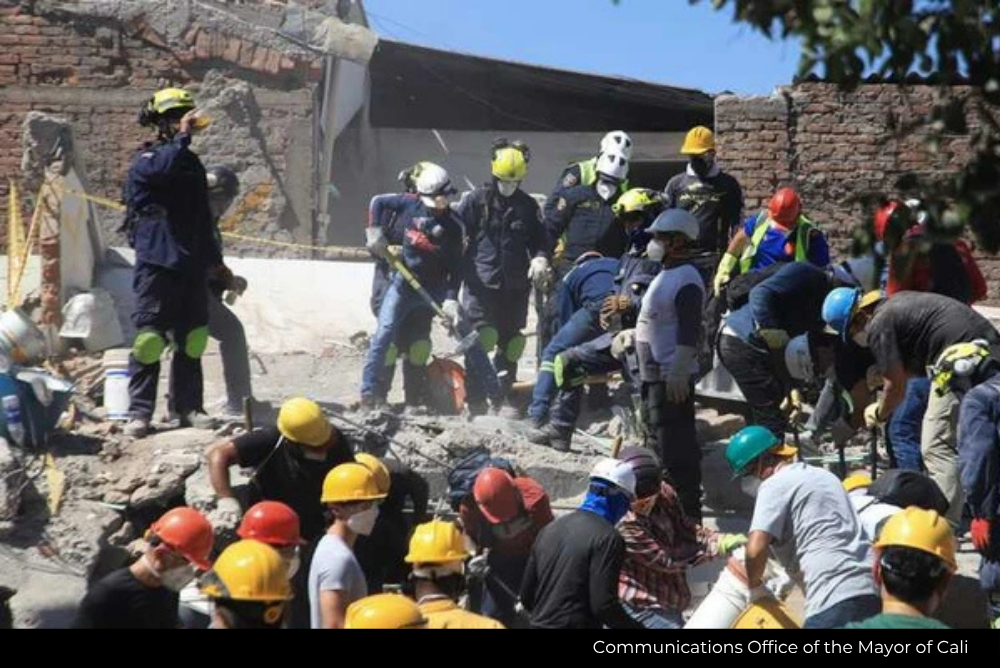
The People's Health Movement expresses its deepest solidarity and support for the people of Colombia following the devastating 7.4-magnitude earthquake that struck the western part of the country on August 10, 2026. Seventy-two hours after the tragedy, the toll reported by authorities stands at 273 dead, 3,824 injured, and 377 missing, while more than 97,515 people have been impacted, 172 buildings collapsed and 12,584 structures have been damaged throughout the western region of the country.
We share in the grief of the families who have lost loved ones, the anguish of those still searching for missing persons, and the suffering of the communities that have lost their homes and livelihoods. The hardest-hit cities and regions face an especially difficult situation, as aftershocks continue to endanger the population and response teams.
We deeply recognize and value the work of healthcare workers, firefighters, search and rescue teams, community organizations, volunteers, and all those who, under extreme conditions, continue to search for survivors, care for the injured, and support affected families. Their commitment and solidarity are a concrete defense of life and an expression of the strength of Colombian communities.
We call for ensuring the basic humanitarian needs of those affected—families who have lost their homes and livelihoods, as well as populations facing particular risks.
The emergency will not end when rescue operations conclude: it will be necessary to ensure decent housing, the restoration of homes, the reconstruction of schools and health facilities, the restoration of public services, and support for community economies. Reconstruction must be carried out with the effective participation of the affected communities, guided by principles of equity, safety, and risk reduction.
We call on health activists, PHM circles, and allied organizations in Latin America, the Caribbean, and around the world to strengthen solidarity with the Colombian people. We invite you to support credible humanitarian efforts and to contribute to a response that places the lives, dignity, and rights of those affected at the center.
In this time of grief, we reiterate our appreciation for the Colombian communities that are organizing, caring for one another, and supporting each other. Solidarity among peoples can save lives, alleviate suffering, and support the reconstruction effort.
Our solidarity stands with Colombia—today and throughout the entire recovery and reconstruction process.
Solidarity is what unites peoples. Now is the time to put it into practice.
Civil society’s response and solidarity in the face of the humanitarian crisis in Colombia after the earthquake
Bogotá, Colombia, August 13, 2026
As women and men working in the healthcare sector, with extensive experience in the field of public health, we are deeply moved by the national tragedy of the earthquake that occurred on August 10, and we issue this statement to the public and the authorities in solidarity with the affected communities and in defense of life.
The earthquake has struck more than one-third of the country’s territory, leaving a preliminary toll—72 hours later—of 273 dead, 3,824 injured, and 377 missing, as well as severe damage to infrastructure and vital resources, and immense pain and suffering. This catastrophe, combined with the chronic structural crisis in the health system, constitutes a humanitarian crisis in the affected areas, which demands that the national health authority reclaim its role to ensure an immediate, comprehensive, and effective state response, as well as the organization of national solidarity and broad, inclusive acceptance of international cooperation.
Although formal emergency mechanisms exist, the absence of effective and guiding management by the Ministry of Health in the face of this catastrophe is appalling; its inaction and lack of coordination with local authorities to orchestrate a sector-wide, short- and medium-term response is evident in an emergency decree (Decree 1171 of August 11, 2026) that ignores critical health needs and fails to assign clear responsibilities, relegating the health system—which is fundamental to the preservation of life—to a marginal role in the face of the crisis. This institutional paralysis is exacerbated by the lack of accurate official information on the impact on hospital infrastructure and the shortage of supplies and medications, which prevents even minimal strategic planning.
To address the humanitarian crisis, the following is required:
1. Address the social determinants of health by ensuring access to safe drinking water and basic sanitation, food and nutritional security, and safe housing and shelters, among other measures. Systematic epidemiological surveillance is required, along with vector control and management of consumption-related risks.
2. The immediate establishment of emergency care services, as well as ensuring supplies of medications, biomedical equipment, and medical transport, without administrative delays, avoiding operational fragmentation, and coordinating existing resources in the territory, such as Basic Health Teams, and within the framework of Resolution 1731 of August 5, 2026, regarding the provision of services in the event of emergencies and disasters. A networked response that involves all actors in the system, particularly hospitals and public health laboratories. The State’s inaction and invisibility in managing the hospital crisis are unacceptable.
3. Interdisciplinary and comprehensive care with territorial coverage. The Ministry must lead strategic planning that moves beyond improvisation, aimed at minimizing harm to physical, mental, and psychosocial health that could have medium- and long-term impacts on the population, with a priority focus on women, children, older adults, people with disabilities, and ethnic, rural, and peasant communities, who face greater vulnerability due to the lack of basic services. In any case, comprehensive care for the entire population must be maintained.
4. Guarantee the physical, mental, and psychosocial safety of health care workers, particularly those working on the front lines under precarious conditions, in accordance with the guidelines of the Public Policy on Human Resources in Health (Resolution 1444 of July 11, 2025).
5. A National Plan for the Recovery of Health Infrastructure, which must be based on the optimization and full utilization of existing resources and coordinated with local authorities.
6. Extraordinary funding using existing mechanisms for the efficient and transparent use of resources and - Citizen oversight, to guarantee barrier-free access to health services. The state budget must be prioritized toward social investment, ensuring the reconstruction of housing, schools, universities, hospitals, and drinking water networks, among other public services. Looking to the immediate future, the country must reject spending on mega-prisons and reduce military spending, financing these projects without resorting to more foreign debt—a burden that ultimately hits the pockets of the most vulnerable families the hardest.
The Colombian people’s response, driven by solidarity and humanitarianism, has been admirable, but it cannot be obstructed, co-opted, or continue to fall exclusively on their shoulders. The national government and local governments have an obligation to support this effort with resources and capacity.
Protecting the lives and health of the most vulnerable populations cannot wait. We know that in the first 72 hours, the massive presence of rescue workers saves lives, which is why the national government’s politically biased acceptance of international cooperation is regrettable. The population cannot be denied the right to receive humanitarian aid under the pretext of self-sufficiency. Therefore, it is essential that the principles of neutrality, impartiality, independence, and non-discrimination under humanitarian law and the medical mission be respected.
The guiding principle must be to save and uphold the dignity of life. We express our profound solidarity with the families and loved ones of the victims; we understand that these losses affect the development of our future.
We will continue working to defend life and health.]
In solidarity and with love for the people,
Health Workers for Life
Signatories:
People’s Health Movement (PHM)
Latin American Association of Social Medicine and Public Health (ALAMES)
Corporation for Popular Health Guillermo Fergusson Group
Luis Hernando León Burbano - ANTHOC
Jorge Iván Posada Vélez ASMEDAS Antioquia
PhD Nancy Jeanet Molina Achury - Guillermo Fergusson Group
Walter Iván Ávila Ramírez - Sumapaz Research Group
Eliana Mongui Ávila - Women and Economy Roundtable
Ilval José Muñóz Ramírez - Drug Information Center of the National University of Colombia
Claudia Beatriz Naranjo Gómez - Latin American Association of Social Medicine and Public Health
Juliana López Méndez - IFARMA Foundation
Ingrid Josefina Romero Araujo - People’s Health Movement
Isabel Cristina Bedoya - People’s Health Movement
Emilio Suniaga ALAMES - PHM - TELESUR
Herland Tejerina - ALAMES Bolivia
Oskar Matias Sabatini Rodríguez - Somos Network
Alicia Guerra - ALAMES Uruguay
Victoria Segovia LAICRIMPO - National and Latin American Health Movement
Adriana Patricia Camayo Otero - MAELA
Gerardo Segovia RAOM - Misiones Organic Agriculture Network (Argentina)
Antonio José Álzate Vargas - Community Action Board of La Aguadita Village in Fusagasugá Cundinamarca
Gilberto Martínez Prado - Social, community, or human rights leader ANPRESS Colombia
Irma Llanos Social, community, or human rights leader Colectivo Polinizadores Jaime Urrego Social, community, or human rights leader Health Movement Jhon Alexander Penagos Torres Social, community, or human rights leader Valores y Talentos
Marina Jimena Joski Social, community, or human rights leader Barrios de Pie María Victoria Berrios Pérez Social, community, or human rights leader Health Forum Sonia Rosa Castañeda Roncancio - Citizen
Gloria Evalina Leal - Citizen
Keiver Darío Cardona Zapata - Citizen
Álvaro Rodríguez Núñez - Citizen
Keiver Darío Cardona Zapata - Citizen
Luis Orlando García - Citizen
Deisy Arrubla - Citizen
Joshua Samuel Pimiento Montoya - Citizen
Luis Alberto Martínez Saldarriaga - Citizen
Carlos Iván Pacheco Sánchez - Citizen
Eliana Sofía Angulo Valencia, - Citizen
Lina Alejandra Padilla García, - Citizen
Marcela María Ortiz Torres, - Citizen
Sandra Payán, - Citizen
Laura Milena Rodríguez, - Citizen
Carlos Fernando Torres Almonacid - Citizen
Diana Esmeralda Moreno Abaunza - Citizen
Mónica Marcela Durango Quintero - Citizen
Karen Vanessa Perdomo Estrada - Citizen
Diana Paola Bolaños Gómez - Citizen
Mario Esteban Hernández Álvarez - Citizen
Laura Margarita Bello Álvarez - Citizen
Carmen Eugenia Quiñónez A - Citizen
Luis Orlando García - Citizen
Álvaro Rodríguez Núñez - Citizen
Keiver Darío Cardona Zapata - Citizen
Sonia Rosa Castañeda Roncancio - Citizen
Gloria Evalina Leal - Citizen
Laura del Pilar Escobar Buitrago - Citizen
Excerpts from the PHM's press release were generated using AI tools and translated with DeepL