
New PHM global coordinator: “Palestine is a symbol of resistance for a new world”
Pharmacist Aziz Rhali is to lead PHM with a vision of Palestine as global resistance symbol, advancing the health movement’s strategic vision.
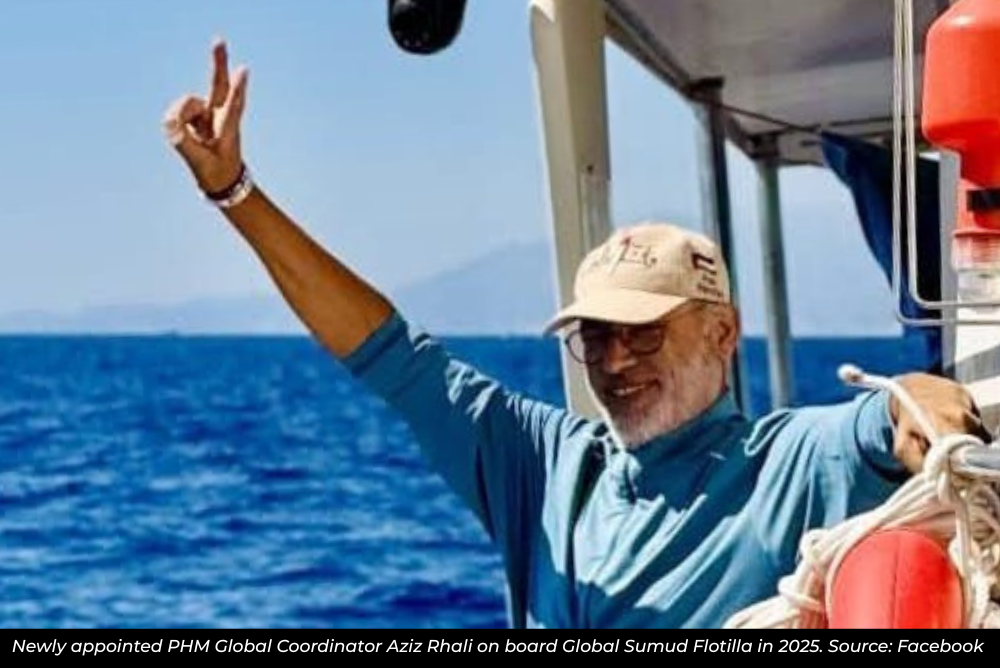
The People’s Health Movement (PHM) has appointed pharmacist Aziz Rhali as its new Global Coordinator. A former President of the Moroccan Association for Human Rights and member of the Board of Directors of the Global Sumud Flotilla, Rhali will succeed Roman Vega while overseeing the partial relocation of PHM’s Secretariat to its Middle East and North Africa (MENA) region.
In this interview, PHM Europe co-coordinator Juliette Mattijsen and Rhali examine the political moment coinciding with the start of his coordination term, PHM’s plans and vision for the coming period, and the significant challenges ahead.
Juliette Mattijsen: The reason we’re meeting today is that PHM is transferring its coordination from Latin America to the MENA region, which is of course a significant change in a particularly unstable global context. Can you explain why this move is so important?
Aziz Rhali: Yes, I agree the transfer of the Global Secretariat to the MENA region is very significant. Quite simply because in recent years, the MENA region has been the most inflamed region on earth, to use medical terms. In addition to that, there have been quite a few changes in recent years – and more will arise in the future – regarding stability and health.
If we map out the region a little, we find areas under very significant pressure. For example, there is the absence of a state that must guarantee the right to health and other rights, for instance, in Libya, Sudan, Syria, Yemen, and Lebanon. We are in a situation where there is no state with which we can talk there, but we can still push for recognition of the right to health and stability. The situation in Iraq is not much better, and Iran is on the brink of a major war in the region.
Then, there is the issue of Palestine. We are still witnessing a genocide. It is true that many people are no longer talking about it, even though it continues. And beyond genocide, we are now talking about something else: ethnic cleansing. There has been a total destruction of living conditions in Gaza. We’re also starting to hear a little bit more about the same things happening in the West Bank and other parts of Palestine, which are also threatened by the Israeli state with the support of the Americans.
All these things raise the question for us as health activists. I’m not just talking about protecting the right to health because for us democracy is an essential element. The socio-economic determinants of health are essential.
So, I think that by transferring the global secretariat to the region, PHM is showing that it wants to be at the heart of activities in the region, which is, we could add, very close to Europe – a Europe undergoing change with the rise of the right and the far right, as well as in the context of many values that we have defended for years and years. For me, coming to this region, the Mediterranean, is a bit of a consolidation of PHM’s work.
JM: You’ve already mentioned solidarity with Palestine, which has also been a central element in PHM’s vision since its creation 25 years ago. With the transfer of coordination to the MENA region, how do you think this will strengthen this work of solidarity?
AR: When we talk about PHM in Palestine, we need to go back in history. In 2000, when PHM was created, there was a proposal that Mustafa Barghouti should be the Global Coordinator of PHM. This was to show that Palestine is at the center of PHM’s thinking and work. And the secretariat was transferred to Egypt during one of the first coordinations of the movement, to be close to Palestine and to ensure that Palestine was always supported.
In the MENA region, we’ve always opted for a Palestinian representative as regional coordinator. That way, Palestine is always present in the debate, and it will be present now with the Global Secretariat in the region. For us, the Palestinian question is a priority. It’s not just for solidarity, but also for support, because it concerns all the countries in the region. For example, when we talk about Palestine in Morocco, it is a national issue. It is an issue that directly concerns Morocco and Algeria, and everyone else in the region.
I should also mention that when we talk about Palestine in this context, we are talking about Palestine from the sea to the river. That is to say, we are talking about all of Palestine, and we see the Palestinian question as an act of national liberation. We will support Palestine until the liberation of Palestine – all of Palestine.
JM: In previous conversations, you also explained how solidarity with Palestine was decisive in your activist journey. From your training as a pharmacist to participation in the Global Sumud Flotilla last year, how will this experience influence your approach as the new coordinator of the PHM?
AR: I think this does not apply just to me but to all human rights activists in the region. The Palestinian question is a central issue. Since I was in high school, everyone here has been organizing what we call Land Day on March 30 – we organize days of solidarity, activities with Palestine. It’s really an issue we’ve grown up with, through this organized solidarity.
I also had the opportunity and the honor to visit Gaza twice, in 2008 and 2014, so I know a little bit about the Gaza Strip. I worked there, in Al-Awda Hospital, and I know quite a few areas, neighborhood by neighborhood, region by region.
But again, it’s not just me, all PHM activists consider Palestine to be a priority issue. From Australia to the United States to Canada, all PHM activists have this distinction from many other movements. Our position is very clear: we stand with Palestine, we stand with the liberation of Palestine, all of Palestine.
In fact, when I think about our last Steering Council meeting that was held in Morocco, everyone noticed that when we started talking about circles and regions and activities, unanimously, all the regions were focused, in one way or the other on the issue of Palestine.
In our daily work, whether at the global, regional or national level, the question of Palestine is a fundamental issue and a priority for our work because we see it as an element of liberation for the whole world. In a way, at different points in history, we talk about places that resist for the liberation of the whole world: we talked about Vietnam, we talked about Stalingrad.
In our time, Palestine is a symbol of resistance for a new world, a world where there is equity, a world of justice – because that is our goal at PHM. PHM is not solely a movement working on health or an NGO seeking to provide a small amount of service. No, we are a movement that addresses the issues of justice, democracy, and decolonization throughout the world, and we are part of a global movement that works – not dreams – to bring justice to the whole world.
JM: The boycott campaign against pharmaceutical company Teva, as part of the BDS movement, has highlighted the complicity of companies in genocide, but it can also remind us of the importance of building alternative pharmaceutical models. For several years now, as PHM, we have been implementing the Public Pharma project. How important is this agenda in the current global health landscape?
AR: A lot of work has been done on this, both through PHM and other associations. We worked, for example, to show that there are quite a few countries in the region that were purchasing generic drugs, and we found that there are quite a few Israeli laboratories that apply to these calls using the names or pseudonyms of Indian or Mexican laboratories.
We were able to expose this situation and stopped quite a few deals. Three years ago, we stopped a major deal that a Mexican laboratory wanted to make with Algeria for cancer medicines – only that it was actually an Israeli laboratory. Similar things apply to Libya and many other countries in the region. The campaign to boycott Teva, of course, fits into the logic of this work, but we’re also looking to reinforce and expand it – because it’s not just Teva. In the region and on a global scale, there are now quite a few agreements that have been signed by Israeli laboratories with quite a few laboratories in these countries. We must expose them and unmask them.
Similarly, we need to dedicate more time to the BDS campaign with regard to the academic boycott because we can also show how this state, which has committed genocide – and not for the first time – has no place either as a state or as a laboratory or as an institution in global collaborations. There is a great deal of work being done with medical institutions to ensure that complicit Israeli institutions no longer have a place in the global work of medical institutions.
Now, to the second part of your question. The Public Pharma project is very important because it enables us, as movements of the South and movements that envision a different kind of world, to set an example in the pharmaceutical field. It brings concrete examples of what states can do to build Public Pharma, including state-owned pharmaceutical production and medicines that can be sold at truly affordable cost.
For example, let’s take the drug called Solvadi or other drugs for the treatment of hepatitis C. US laboratories sell it for $86,000. In Europe, it is sold for €70,000. In many other countries, it is sold for €10-15. The cost price of Solvadi does not exceed €1.50. So, you can well imagine the practical difference in going from a price of €1.50 to €80,000.
Through the Public Pharma project, we want to show that we can save lives, that we can make drugs affordable, that drugs are expensive because of Big Pharma. There are no expensive drugs. There is expensive healthcare for citizens, guided by Big Pharma with significant interference from political actors. For example, one of the last CEOs of Gilead Sciences was Donald Rumsfeld, former US Secretary of Defense (or War). This should give us a very clear example of the interconnectedness of the political and the pharmaceutical sphere.
It’s a big battle, but we have to fight it and win. I think we’ll find a lot of solidarity in quite a few countries.
JM: Another big question: we are obviously going through an exceptional period with the influence of the US in the world seemingly in decline and their particularly aggressive reaction, the blockade against Cuba being reinforced, Venezuela being attacked and its president kidnapped, and Iran and Mexico being threatened on a daily basis. What impact does this situation have on the right to health, for which PHM has been fighting for a quarter of a century, and how does the movement intend to respond?
AR: I think that this question of the domination of imperialist hegemony embodied by the US has led people in quite a few regions to debate issues of sovereignty, development, social justice, and to protect the integrity of the countries where they live. Now, in this situation, the US is trying to keep afloat and fueling all these crises, but they’re seeing resistance.
However, I believe we should not focus solely on the US. Recently we’ve had an agreement that was signed between the European Union and India, as well as an agreement between the EU and Mercosur. We must also study these developments because, for example, a large part of the EU-India agreement focuses a lot on intellectual property, on patents, and so on.
That said, we will not give up on the solidarity with peoples under assault by the US. As PHM Latin America and global, we will be there for the solidarity flotilla to Cuba expected in May. We will be there with the Cuban people, standing up against the aggression they’re witnessing from the US. I emphasize that it’s an aggression because now in Cuba, many ports have been closed due to the lack of fuel. The US is committing a silent genocide against the people there, and this is being hidden away from the public.
But the situation is serious, and I think we owe Cuban people a great deal of solidarity because they were present everywhere. Cuban doctors, for example, during the COVID-19 pandemic, traveled all over the world to bring aid to the people in many countries, even in European countries. We must also recognize the importance of Cuba for many countries in Africa and Asia. The Cubans were always there for us.
It’s up to us now to organize a great chain of solidarity with the Cuban people. We have seen what happened in Venezuela and in Cuba, and we must know that tomorrow or the day after tomorrow, there will be other countries meeting the same kind of assault.
These attacks on international law charged by the US administration will have harmful effects on the whole world. I think that we, as PHM, must take responsibility by denouncing it, by setting up solidarity campaigns, and by raising our voices very loudly. We must also work to promote alternatives. For example, when we talk about BRICS countries, we must push the BRICS group to shape a response to what is happening around the world.
JM: We are also seeing crises at the level of international and multilateral institutions. They too are under attack from the Trump administration and its allies. How do you think this field will evolve and what space can the PHM claim, given its historical role as a critical observer at the WHO?
AR: I think that the dismantling of United Nations agencies began with Donald Trump’s first presidential term. One of his goals is to destroy the UN, simply because he doesn’t believe in multilateral agreements. He only talks about bilateral ones. That is, agreement between the US and a given country with very clear conditions in favor of the US. For Donald Trump, multilateral agreements hinder the development of the US and impede the development of the capitalist world.
There have been things that have happened quietly, for example, obstructions at the World Trade Organization (WTO). Then they moved on to UNESCO, then the WHO, and then he worked on the destruction of UNRWA and other multilateral institutions. For him, the UN in Palestine represents the claim to the right of return and it is the body that speaks for Palestinian refugees. And I think that this “peace council” Donald Trump has created is only an alternative to the UN – his own Trumpian UN.
However, while the Trump administration might have started out to destroy these organizations, there are unfortunately quite a few countries that are now helping the US in this endeavor. For example, I find it shameful to hear the French foreign minister calling for the resignation of UN Special Rapporteur Francesca Albanese. Consciously or unconsciously, quite a few European leaders are helping destroy the UN.
We need to mobilize fast because things have started to become very difficult, especially with the disappearance of what we used to call the non-aligned countries, or what we call in the UN the Group of 77 (G77). We must revive the G77 because, true, the UN is not doing its job as well as we would like, but it maintains some ideas that we all believe in. For example, the Rome Declaration and the construction of the International Criminal Court (ICC) was something the whole world dreamed of. We dreamed of a court where people who violate human rights, humanitarian rights, would be tried – and that is being dismantled today.
Despite their problems, our role is to strengthen these bodies, not destroy them. We are starting to hear people saying that we don’t need human rights, that human rights don’t do anything, that there are double standards inside the UN and we should do away with it. But no, we must strengthen the issue of human rights, we must strengthen and improve the work of UN agencies, because with their disappearance, we’re looking at a disaster on an international scale.
I think that, despite all its problems, from 1945 until the rise of the Trumpist movement, the UN has actually saved many lives around the world. The destruction of this body will put a lot of countries at risk, a lot of minorities in many countries and regions will suffer from the disappearance of the UN.
Our role as PHM is to continue our work, including by organizing meetings with BRICS health ministers and pushing them to maintain their role in multilateral agencies so that the WHO can play the role for which it was created. The WHO has started to withdraw a little from the global arena, and we must push it to return.
We saw the importance of the WHO during COVID-19, and we should strengthen it so it can fully live up to its role as envisioned in 1948 when it was created. Even when it comes to the right to health, it was the WHO who gave the broadest and most accurate definition of the right to health – one that we don’t even find in the International Covenant on Economic, Social and Cultural Rights. Because when the WHO was created, we talked about the potential of the whole world to achieve health from a moral, physical, and social point of view.
The word “social” has disappeared from the International Covenant on Economic, Social and Cultural Rights and also from quite a few other covenants. So when we think of the full definition of health, we owe a lot to the WHO. Similarly, for us as PHM, the basis of our work shares a lot with the WHO’s Alma-Ata Declaration.
In a few years’ time, we will be celebrating the 50th anniversary of the Alma-Ata Declaration. As we prepare for this, we need to keep in mind this legacy and strengthen the work of the WHO and other UN agencies.
JM: Finally, regional and national circles have always been at the heart of the PHM. What are they currently organizing around? Can we already talk about their – and PHM’s – priorities for 2026 and 2027?
AR: PHM’s strength truly lies in the strength of these circles. We cannot talk about a PHM if the circles at the national and regional levels are not strong. So we need to work more with the circles, make a real map, and ensure there is learning among our different circles. We have different circles in many countries, but we are united through our values and the People’s Charter for Health.
We must make sure that there is dialogue between the PHM circles at all times, not only when we have international assemblies or need young activists to mobilize. There are quite a few ideas that I am currently looking into to strengthen this area of work. For example, if I am in Morocco, working on the right to health in a circle, I can invite a comrade from Côte d’Ivoire or any other French-speaking country – because language is still a consideration to make – to spend a month with us. We take care of them, and they see how our circle works. They will try to transfer the know-how from Côte d’Ivoire here to Morocco, and the other way round. Similarly, we can try to create this exchange between India and Latin America, so that we can strengthen our presence.
This can help us to strengthen the work of the circles. For example, in India, PHM activists do a lot of mobilization and actions with grassroots associations. Similarly, our Palestinian comrades have done a great deal of work in the community. How can we transfer this expertise, which has been developed over many years in India, to other countries? How can we transfer it to Morocco? How can we transfer it to Latin America?
In other countries, the situation is different, we might have only initial contacts. For example, in Yemen, activists might want a transfer of knowledge on the issue of health, whether from the Health Work Committees, the Palestinian Medical Relief Society, to learn how to most effectively work in their own circumstances.
We may have comrades from Palestine who can, for example, go and support organizing in Sudan, where we don’t yet have a circle, but we do have focal points. How can our PHM comrades play a role in strengthening our work around the world? The answer to this question would enable various PHM circles to develop and exchange ideas among ourselves, bringing forward our work. Because ultimately, we are not a health management company – we are a movement that campaigns for the right to health and for social and health justice around the world.
This interview was facilitated by PHM Global as part of People’s Health Dispatch – a fortnightly bulletin published by the People’s Health Movement and Peoples Dispatch.