

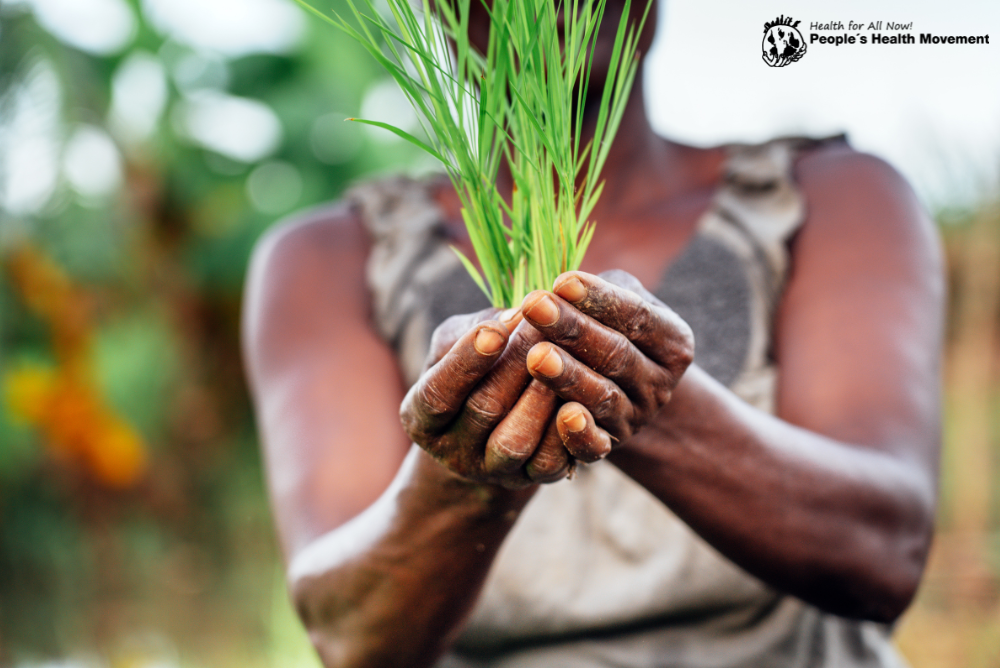
Food is a Human Right, Not a Privilege!: An Activist's Call for Food Justice, Peace and Dignity in Africa
The People's Health Movement in Southern and Eastern Africa is launching its declaration for justice, peace, dignity, and food sovereignty. As the world commemorates World Food Day, it is urgent to shed light on a reality that we cannot continue to normalize: millions of people, especially in Africa, continue to suffer from hunger in a world that produces food, but where wealth and resources are distributed unequally. Poverty, armed conflict, climate change, and unjust policies exacerbate food insecurity, making it clear that ensuring access to nutritious food is not an act of charity, but a collective responsibility and a fundamental human right.
For millions of Africans, food insecurity is not an abstract statistic. It is a mother skipping meals so her children can eat. It is a farmer watching months of hard work destroyed by drought or floods. It is a child attending school on an empty stomach. It is a family forced to choose between buying food, paying rent and accessing healthcare.
And in war-torn communities, hunger can mean something even more devastating: families fleeing their homes, farmers abandoning their land, markets being destroyed, humanitarian assistance being blocked and food becoming a weapon of war.
Hunger is not always caused by a shortage of food. It is also caused by poverty, inequality, conflict, unjust economic systems and political choices.
1. Africa: When farmers work hard but families still go hungry
Africa has enormous agricultural potential, fertile lands, hardworking farmers and rich indigenous knowledge. Yet many communities continue to face hunger and malnutrition.
Smallholder farmers struggle with rising input costs, limited access to credit and markets, inadequate irrigation, land pressures and the growing impacts of climate change. Droughts, floods, cyclones and unpredictable rainfall can destroy crops and livelihoods. Women, who contribute significantly to food production and household food security, often face unequal access to land, finance and productive resources.
The World Health Organization's summary of the 2026 food security report highlights that two-thirds of people in Africa cannot afford a healthy diet.
World Health Organization
As activists, we must ask: Why are the people who produce our food often among those struggling to feed their own families?
We must demand investment in smallholder farmers, local food systems, irrigation, climate-resilient agriculture, storage facilities, rural infrastructure and fair markets. Governments must also protect agricultural land, support women and young farmers, and strengthen public food and nutrition programmes.
2. War and conflict: Hunger as a weapon
In places such as Sudan, the Democratic Republic of the Congo, Somalia, South Sudan and Gaza, conflict has devastated lives and livelihoods. Fighting can force farmers from their land, destroy markets and infrastructure, disrupt supply chains and prevent humanitarian assistance from reaching people in need.
The World Food Programme identifies conflict as a leading driver of many major food crises, with roughly 70% of people experiencing acute food insecurity living in fragile or conflict-affected countries.
World Food Programme
For displaced families, food is not simply a matter of nutrition. It is survival.
We must demand that food, water and humanitarian assistance never be used as weapons of war. Civilians must be protected, humanitarian workers must be able to reach people safely, and parties to conflicts must respect international humanitarian law.
There can be no meaningful food security without peace, justice and protection of human dignity.
3. Food justice is health justice
As the People's Health Movement and other health justice activists remind us, health is shaped by the social, political and economic conditions in which people live.
A child who is chronically hungry cannot learn effectively. A pregnant woman without adequate nutrition faces increased health risks. A family that cannot afford nutritious food may experience malnutrition even when some food is available. Hunger also weakens people's ability to work, study and participate fully in society.
Food insecurity is therefore not only an agricultural issue. It is a public health issue, a human rights issue and a social justice issue.
We must connect the struggles for food sovereignty, universal healthcare, decent work, social protection, gender equality and climate justice. People cannot enjoy their right to health when they cannot reliably access adequate, safe and nutritious food.
4. What must activists demand?
World Food Day must become a platform for action, not just commemoration.
Governments: Prioritise food security, nutrition, public agricultural investment and social protection. Make food policies transparent and accountable.
Farmers' movements: Defend smallholder agriculture, agroecology, local seed systems and communities' rights to land and water.
Civil society and health movements: Challenge policies that deepen hunger, inequality and dependence, and demand that food systems serve people rather than profit alone.
International institutions and donors: Increase support for emergency food assistance while investing in local production, livelihoods and long-term resilience.
Communities and citizens: Organise food cooperatives, community gardens, local seed initiatives and mutual-aid networks, while holding decision-makers accountable.
FAO's 2026 World Food Day theme is “Innovate today. Nourish tomorrow.” Innovation matters, but it must benefit ordinary people, build on local knowledge and remain accessible to smallholder farmers and vulnerable communities.
FAOHome
+1
5. Our call to action as activists
On this World Food Day, let us refuse to normalise hunger.
Let us stand with the rural farmer whose harvest has failed, the mother who cannot afford three meals a day for her children, the displaced family fleeing conflict, the community facing drought, and the worker whose wages cannot cover the cost of nutritious food.
Let us challenge governments when they neglect food security. Let us demand accountability when resources are mismanaged. Let us defend communities whose land and livelihoods are threatened. And let us build solidarity across borders, because hunger does not recognise national boundaries.
We cannot speak about human dignity while millions are denied the food they need to survive. We cannot speak about health for all while nutritious food remains unaffordable for so many. And we cannot speak about peace while families are deliberately starved or deprived of humanitarian assistance.
Food is not a privilege reserved for the wealthy. It is a basic human necessity and a fundamental human right.
This struggle requires more than charity. It requires solidarity, public investment, just policies, community power and sustained political action.
Our message this World Food Day
No one should go hungry in a world capable of producing enough food.
No farmer should remain poor for feeding the nation.
No child should be denied a future because of hunger.
No war should be allowed to starve civilians into submission.
Food Justice Is Health Justice!
Health for All, Food for All, Justice for All!