

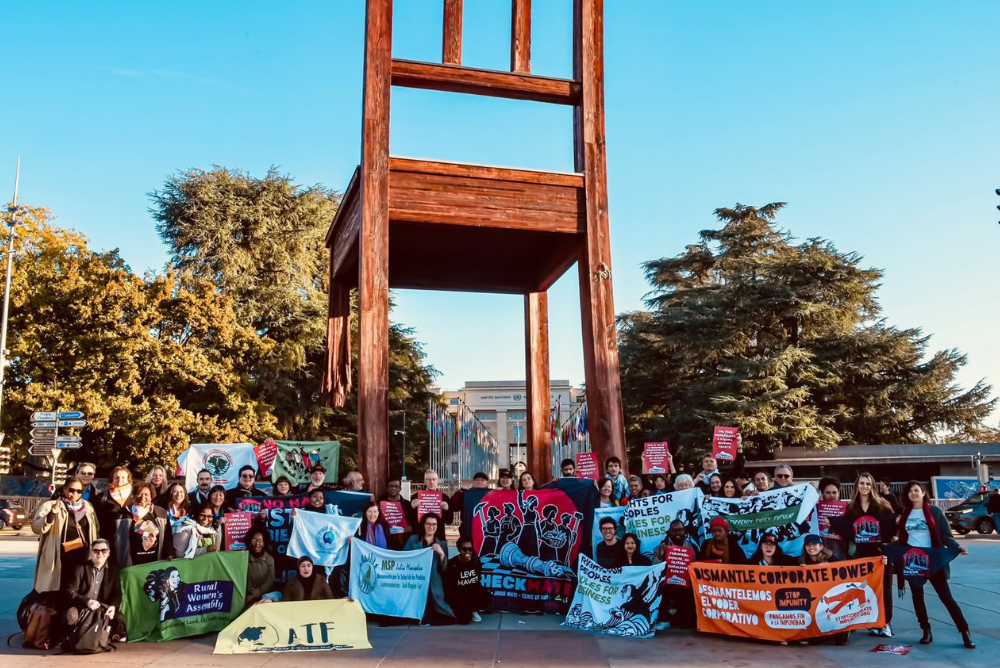
PHM was actively involved in the negotiations for the UN Legally Binding Treaty on Transnational Corporations and Human Rights
The People’s Health Movement and the Association for the Promotion and Protection of Human Rights, XUMEK—both member organizations of the Global Campaign to Dismantle Corporate Power—participated in Geneva in the 12th session of the United Nations Open-Ended Intergovernmental Working Group.
At this meeting, María Natalia Echegoyemberry (Member of the PHM’s South Subregion) participated on behalf of the People’s Health Movement and XUMEK, arguing for the need to move toward a legally binding treaty that would establish an international tribunal with the authority to enforce its provisions and determine the international liability of transnational corporations and transnational business activities for human rights violations. She also emphasized that the creation of a committee must be coordinated with the establishment of an effective international judicial mechanism and must not replace or weaken it.
Candelaria Araoz also participated on behalf of the PHM’s South Subregion, linking aspects of food sovereignty to health and the responsibility of transnational corporations.
The Global Campaign also raised the need to strengthen mechanisms for access to justice for victims of human rights violations linked to transnational business activities.
Echegoyemberry’s remarks also highlighted the importance of coordinating the definition of the interpretive powers of the future Committee and those of a potential international tribunal, in order to avoid overlapping mandates and ensure the coherence of the Treaty’s institutional architecture.
Additionally, the Global Campaign proposed that the Committee be structured as a pathway to the international judicial mechanism, drawing on certain aspects of the institutional relationship between the Inter-American Commission on Human Rights and the Inter-American Court of Human Rights.
Among the functions proposed for the Committee were the receipt and examination of individual communications or petitions; the adoption or request for urgent protective measures; conducting country visits and monitoring human rights situations; referring cases to the international court; monitoring compliance with recommendations addressed to transnational corporations; and adopting measures to facilitate the production of evidence, intercultural expert assessments, and interpretation services.
The presentation emphasized that the Treaty’s institutional architecture must be conceived as a coherent system, aimed at strengthening access to justice for victims and affected communities, overcoming jurisdictional barriers, and guaranteeing effective remedies and comprehensive reparations, especially for those living in “sacrifice zones” who suffer the physical consequences of these activities.
The members of the PHM are part of the Global Campaign’s legal team, which has produced various Policy Briefs.
More information on the Policy Briefs:
Primacy over Trade, Investment & ISDS ,
Big Tech & Corporate Accountability
Fishers’ Rights & the Binding Treaty
To follow the sessions at:https://transcripts.un.org/en/asset/k15/k15yahfv81