

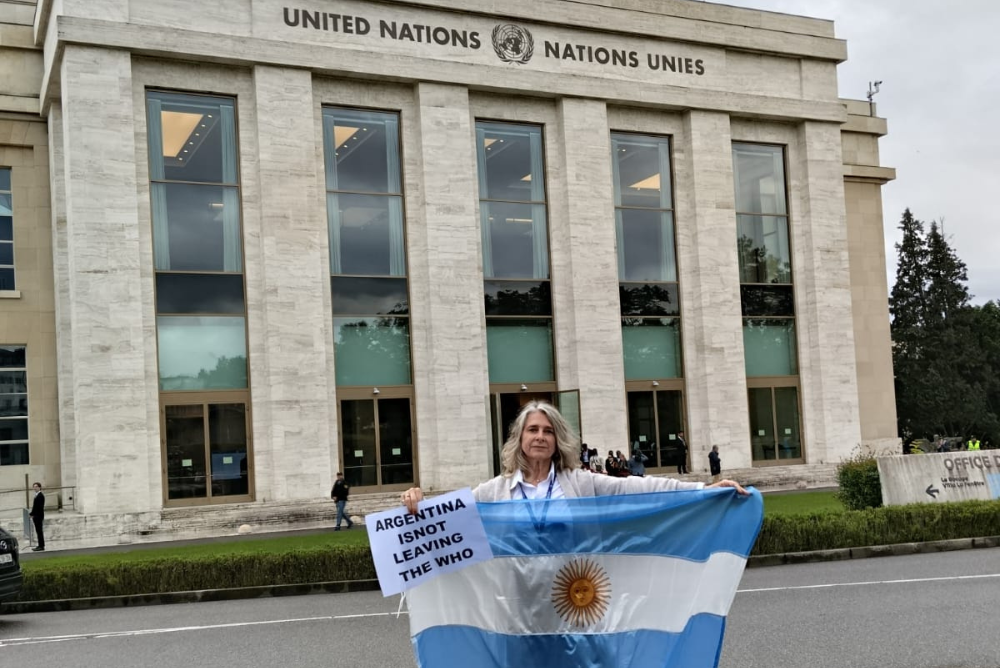
Argentina Announces Withdrawal from the WHO; the World Health Assembly turns it down
Although President Javier Milei’s government formally notified its intention to withdraw from the World Health Organization (WHO)—a decision announced as taking effect on March 17, 2026—the issue became the subject of debate during the 79th World Health Assembly (WHA), held in Geneva last May, rejecting the request.
Argentine civil society organizations and health rights groups affiliated with the People’s Health Movement publicly opposed the decision, arguing that withdrawing from the WHO weakens Argentina’s participation in international health governance and undermines the right to health.
As part of these actions, a delegation from Argentine civil society delivered a letter to WHO Director-General Dr. Tedros Adhanom Ghebreyesus outlining concerns about the current state of Argentina’s health system and questioning the grounds for withdrawal. According to the organizations, the decision reflects political alignment with U.S. President Donald Trump rather than a strategy to strengthen public health policy.
Fernanda Boriotti, President of the Argentine Federation of Health Professionals (FESPROSA), presented the letter during the Assembly and emphasized that international cooperation in health is not an ideological choice but a necessary condition for guaranteeing the right to health. During the WHA, the delegation also participated in side events and discussions with members of the People’s Health Movement and WHO Watchers, strengthening international collaboration around WHA agenda items and the Argentine case.
WHO Director-General Tedros Ghebreyesus reportedly expressed concern regarding Argentina’s position and reiterated the importance of international solidarity and multilateral cooperation in addressing global health challenges.
During discussions at the Assembly, member states did not formally endorse Argentina’s withdrawal. Instead, the WHA adopted a compromise approach: it took note of the withdrawal notification but declined to recognize or legally validate the exit, citing the absence of a formal withdrawal mechanism within the WHO Constitution. This decision avoided establishing a precedent and leaves open the possibility for future Argentine governments to resume full participation without procedural obstacles.
For organizations defending the right to health, this outcome represents both a setback for the current Argentine government’s diplomatic strategy and a recognition of efforts to challenge recent health policy decisions.
The Argentine Federation of Health Professionals (FESPROSA), affiliated with Public Services International (PSI) and linked to regional and global networks of the People’s Health Movement, reaffirmed its commitment to health activism and defending health as a universal right through international solidarity in public health.
Click here to download the letter (Spanish)